
Reasons behind Traffic and Session Drops in 2025–2026: A Shift in Search Behavior, Not the Death of SEO
Your website analytics show a noticeable decline in website visits, and you’re not alone in noticing this trend. The primary reason behind these drops is not the demise of SEO, but a fundamental shift in how people interact with search. In 2025, search behavior evolved rapidly. Today, more user queries are resolved directly on the search results page rather than through clicks to external websites. Independent clickstream data indicates that roughly 58 to 60 percent of Google searches now end without a click, with only 360 to 374 clicks per 1,000 searches reaching sites on the open web in the US and EU.
Another profound change affecting the click model is the rise of AI summaries. For example, in July 2025, Pew tracked 68,879 searches from 900 US users, demonstrating the significant impact of AI on user behavior. When an AI Overview appeared on the results page, users clicked on a traditional search result only 8 percent of the time, compared to a 15 percent click rate when no AI summary was shown. Notably, links within the AI summary itself attracted just 1 percent of clicks.
The 7aeo 2025 Study on Traffic and Session Drops Across 620+ Websites
To understand what’s really driving these changes, 7aeo analyzed data from 642 websites across sectors including SaaS, ecommerce, B2B, and media. The study focused on performance between January and October 2025, comparing year-over-year organic sessions and search query features at scale.
- Median organic sessions decreased by 14.3 percent year over year.
- Informational websites featuring “how to” or “what is” content saw a steeper median drop of 22 percent.
- Branded or navigational pages remained stable, with a median change of only minus 2 percent.
- Queries that triggered AI Overviews saw a median organic click-through rate (CTR) decline of 41 to 52 percent, depending on the industry vertical.
These findings are consistent with third-party research documenting widespread CTR declines when AI Overviews are present, especially for non-branded searches. For instance, Amsive reported an average 15.49 percent reduction in CTR across 700,000 keywords, with a 19.98 percent decline for non-branded queries.
Behavioral data from Pew further illuminates this pattern: users are more likely to end their sessions when faced with an AI Overview, and rarely click on links provided within the summary itself.
Zero‑Click Searches and AI Overviews Reduced Clicks to Websites in 2025–2026
The phenomenon of zero-click searches isn’t new, but its scale is unprecedented. SparkToro’s 2024 study found that close to 60 percent of searches now end without a website click, and nearly 30 percent of all clicks stay within Google’s own ecosystem. This creates greater friction between your content and the end user.
Referrals coming from AI-generated search results are growing in number, though they still make up a smaller proportion than traditional search results. Similarweb reported 1.13 billion AI-driven referrals to the top 1,000 sites in June 2025, a 357 percent year-over-year increase. However, in the same month, Google Search sent 191 billion referrals, highlighting the significant gap that still exists.
The composition of queries has also shifted, with longer, question-based searches becoming more frequent. Pew found that queries beginning with who, what, when, or why were more likely to prompt an AI summary, and searches of 10 words or more triggered AI summaries over half the time. This growth pushes even more upper-funnel topics into the realm of zero-click searches.
Likely Causes Behind Your Traffic Drop in 2025–2026, Based on Data
- Answer containment on SERPs. AI Overviews and richer informational cards satisfy user intent directly on the results page. Independent data reveals substantial CTR losses when AI summaries appear. (pewresearch.org)
- Mobile dominance. The majority of searches take place on mobile devices, where users are less likely to scroll deep and more likely to end sessions quickly. SparkToro’s research underscores stronger zero-click tendencies in mobile searches. (sparktoro.com)
- Click redistribution within Google properties. A growing share of clicks are diverted to Google-owned surfaces like Maps, Images, and YouTube, meaning demand is siphoned even as search volume rises. (sparktoro.com)
- Query inflation vs. stagnant click growth. As search impressions increase, AI elements cause clicks to decrease. Multiple data sources confirm that greater visibility often comes at the cost of lower CTR when AI summaries are present. (amsive.com)
AEO/GEO in 2026 Reshapes Your Visibility Strategy Beyond Classic SEO
While SEO still plays a crucial role, it now shares the stage with Answer Engine Optimization (AEO) and Generative Engine Optimization (GEO). These modern strategies focus on ensuring your content is cited and utilized within AI-powered answers as well as traditional search listings. For a breakdown of how SEO, AEO, and GEO interact, see our guide on the differences between SEO, AEO, and GEO in the new search triangle. This SEO strategy combines tactics for improving search result rankings, optimizing for citation in AI-generated summaries, and incorporating structured data for extraction by search algorithms.
Why pursue citations in AI answers? A 2025 study by Yext, analyzing 6.8 million AI citations from major engines, revealed that 86 percent came from brand-managed sources such as official websites and verified listings. This demonstrates that well-structured, reputable pages are highly likely to supply content for AI-generated summaries.
AI referrals and citations from these summaries are becoming an incremental traffic source you can no longer overlook. (techcrunch.com)
Practical Steps to Adapt Your Site for SEO, AEO, and GEO in 2026
Make Your Pages Unmissable for Both Crawlers and Answer Engines
- Lead with the answer. Start each page with a brief, two-sentence summary that directly addresses the query.
- Structure for extraction. Use semantic HTML, clearly marked sections, lists, step-by-step explanations, and concise paragraphs to aid algorithmic parsing.
- Deploy rich schema. Implement relevant structured data such as Organization, Product, HowTo, FAQ, Article, and Review schemas wherever appropriate.
- Cite sources on-page. Reference credible external resources and display your evidence transparently.
- Publish original artifacts. Use charts, datasets, and demonstrations to elevate your content as a trustworthy, citable source.
- Harden trust signals. Make authorship, publication dates, corrections, and contact options clearly visible to boost citation chances.
- Support both robots.txt and llms.txt. Define fair use rules and track AI model access to your site.
- Measure AI traffic. Set up tracking for AI referrals and monitor how often your content is cited in summaries.
Interested in gaining a deeper understanding of optimizing content for AI-powered search results? Read our complete guide to AEO/GEO strategies for enhancing AI visibility in 2026.
What the 7aeo 2025 Study Suggests You Do Next, By Scenario
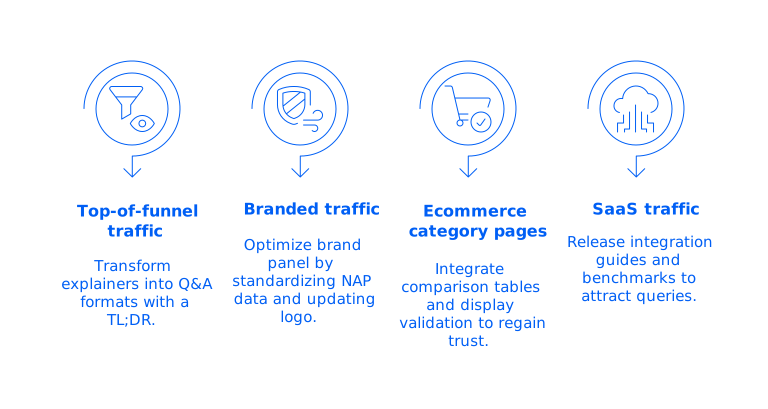
- If you lost top‑of‑funnel traffic: Transform evergreen explainers into concise, source-rich Q&A formats. Begin with a clear TL;DR before expanding in detail.
- If branded or navigational traffic is stable: Optimize your brand panel by standardizing NAP (name, address, phone) data, updating your logo, and connecting social profiles.
- If ecommerce category pages declined: Integrate comparison tables and display first-party validation, returns, warranties, shipping info, to regain trust and visibility.
- If SaaS traffic stalled: Release integration guides and benchmarks using reproducible methods to attract direct queries and citations.
These approaches align with areas where AI cards surface facts and where users may still require detail found only by visiting your site. Data from Amsive and Pew reinforces these patterns. (amsive.com)
Platforms for AEO/GEO and SEO in 2026 that Can Help
- Yext. Excels in managing local listings and enterprise schema, crucial for feeding data to AI models.
- 7aeo. Specializes in structuring AI-ready pages, news hubs, and glossaries, all optimized for both search and answer engine discovery.
- BrightEdge. Provides tracking on AI Overview presence alongside classic SEO metrics, making it ideal for managing large site portfolios. (marketing4ecommerce.net)
- Schema App or InLinks. Offer tools for adding structured data and supporting internal knowledge graphs, key for extraction by AI engines.
- Similarweb. Provides robust benchmarking of evolving traffic sources, including monitoring trends in AI-driven referrals compared to search. (techcrunch.com)
Your 2026 SEO Budget Should Include AEO/GEO, Not Replace SEO
SEO is not obsolete. Instead, it has become a vital element in a broader stack that now includes optimizing your content for both search results and citation within AI-driven experiences. Allocate your budget for content that ranks highly, earns citations, and establishes brand trust in human and AI-driven search alike. While overall search impressions are likely to keep climbing, expect a portion of clicks to continue shifting toward zero-click outcomes. Insights from SparkToro, Pew, and Amsive all guide in the same direction. (sparktoro.com)
Bottom Line: Your Drop Is Explainable and Fixable with a Dual SEO and AEO/GEO Strategy
Traffic hasn’t vanished, it’s relocated. Your role in 2026 is to pursue it across both traditional search listings and AI-powered answer cards. Develop content that both ranks and earns quotes in AI summaries. Keep measuring your performance in both channels, and continue to iterate and refine your strategy.
Light next step: If you’d like a practical, data-driven assessment of your situation, connect with us at 7aeo.com. We can review your SERP features, citation performance, and schema implementation in a single session, keeping it practical, actionable, and tailored to current trends.
FAQ
Why are my website's organic sessions declining despite strong SEO efforts?
It's not the death of SEO; it's a shift in search behavior driven by AI Overviews and zero-click results. Traditional click-through strategies are falling short because answers are being provided on the search results page itself.
How does AI affect user click behavior in search results?
AI Overviews on search results pages significantly reduce clicks to external sites, as users find immediate answers without needing to navigate away from Google. Invest in optimizing content to be cited within these summaries.
What is AEO and how does it relate to SEO?
Answer Engine Optimization (AEO) is focused on ensuring your content is featured in AI-generated responses, complementing traditional SEO efforts. It enhances visibility in search by addressing AI's role in digesting and displaying content.
What role does structured data play in modern SEO strategies?
Structured data enhances your site's content extractability for AI and search engines, making it crucial for higher visibility and better integration in AI responses and search results. Neglecting this is a direct path to lower visibility.
Is traditional SEO still relevant in 2026?
Absolutely. Traditional SEO remains a critical component of a broader strategy that includes both AEO and GEO. Ignoring these new elements will limit your ability to capitalize on AI-driven search trends.
How can I adapt my SEO strategy to include AEO and GEO?
Focus on creating concise, structured content with clear sources that can be extracted and cited by AI. Partnering with platforms like 7aeo can streamline this process, providing tools and insights to optimize your strategy effectively.
What changes can cause a website's branded traffic to remain stable?
Branded traffic is typically resilient due to its strong association with known entities. Maintaining stable branded traffic involves optimizing brand identity features, such as NAP data and social profiles, ensuring they are up-to-date and cohesive.
Should my SEO budget include AEO/GEO strategies?
Yes, your budget should balance across SEO, AEO, and GEO. This ensures a well-rounded approach that maximizes your content's potential to rank, be cited, and maintain relevance in an evolving search ecosystem.