
Stop chasing blue links. Start owning answers.
Search is evolving from simple links to direct answers and comprehensive summaries. By 2026, visibility means ensuring your site appears within AI-generated responses, not just traditional search results. Achieving this demands a different approach to content creation, structure, and signaling.
AEO (Answer Engine Optimization) is focused on ranking in answer engines and AI overview results, while GEO (Generative Engine Optimization) aims to appear in full generative AI responses. Both are essential. You’ll also need editorial processes that treat your website as the authoritative source of information.
AEO vs. GEO: what actually differs in 2026
- Surfaces: AEO targets AI overviews, citations, and instant answers. GEO aims for inclusion in long-form AI-generated outputs.
- Units: AEO prioritizes quick snippets, stepwise guides, and factual breakdowns. GEO concentrates on building context, extended reasoning, and coherent paragraphs.
- Signals: AEO relies on structured data, schema, provenance, and FAQ integration. GEO requires deeper entity coverage, logical flow, and robust trust signals.
- Feedback loops: AEO measures the share of citations attributed to your content. GEO tracks how often your information is generated or mentioned across AI assistants.
Consider AEO as an approach to instantly delivering concise answers to queries, while GEO shapes the narrative and depth of information in responses. Both strategies should work in tandem for comprehensive visibility.
The new ranking signals answer engines read
Modern engines and AI assistants prioritize content that is trustworthy, recently updated, and well-attributed. Whatever you publish should demonstrate a clean and accessible structure. Here are the most vital signals now:
- Grounding: Make clear claims, always supported by citations, datasets, or calculations.
- Structure: Implement detailed schema, logical headings, and reliable permalinks.
- Recency: Keep your content fresh and relevant with visible updates. Show the dateModified field to reflect the latest update, and maintain changelogs to record and display all changes over time.
- Provenance: Clearly identify authors, including bylines and verifiable credentials.
- Consistency: Ensure that facts are aligned across all formats: web pages, PDFs, and product documentation.
- Coverage: Build out complete clusters of topics, including glossaries and related entities for in-depth reference.
Structure your site for machine recall
Build atomic, reusable answers
Generate concise answer units, responses crafted for specific, high-intent queries. Dedicate one section to each claim or process. Use permanent identifiers for each section, even if the section does not have a visible anchor link; this helps AI engines reference information reliably.
- Publish a dedicated /answers/ or /glossary/ hub.
- Assign one search intent or query per page, leaving a clear question near the top to guide both users and machines.
- Conclude with a list of sources, performance metrics, and notes documenting any recent updates.
Use the right schema blocks
- FAQPage for groups of related, cite-ready questions and answers.
- HowTo for procedural or step-by-step workflows, including materials and costs required.
- Product and Offer for technical specifications, pricing, and availability.
- Article with about, knowsAbout, and sameAs attributes linking to related topics and authoritative sources.
{ @context: https://schema.org, @type: FAQPage, mainEntity: [{ @type: Question, name: What is Generative Engine Optimization?, acceptedAnswer: { @type: Answer, text: GEO aligns your content with how AI systems compose responses. } }]}Create an AEO/GEO editorial system
- Map intents: Document key buyer questions, before, during, and after conversion.
- Cluster entities: Define and catalog your products, features, industries, and problems as entities.
- Draft answer units: Write 120–200 word responses for each question. Always include citations.
- Compose narratives: Assemble these answer units into broader explainers, guides, and comparative pieces.
- Mark up: Add relevant schema and link closely related entities across your topical cluster.
- Review: Have subject-matter experts verify facts, sources, and language for accuracy and clarity.
- Publish cadence: Update your site weekly, and record each change with dates and update reasons.
Keep briefs concise. Specify your target query, entity, key claim, supporting evidence, and required schema type for each new unit.
Metrics that matter in 2026
- AI citation share: Percentage of AI-generated answers that cite your website.
- Passage recall rate: Proportion of your answer units retrieved by AI crawlers.
- Coverage score: Percentage of high-priority intents with published, answer-ready units.
- Answer accuracy: Verified truthfulness of your top content by independent experts.
- Freshness delta: Number of days since critical claims were last updated.
- Non-click impressions: Estimated exposure from AI surfaces, even when users do not click through.
Set custom thresholds for different content segments. Raise requirements for regulated or high-stakes content.
Technical checklist for AI visibility
- Ensure all primary content is in clean, crawlable HTML. Avoid hiding essential information behind JavaScript.
- Publish XML sitemaps for /answers, /glossary, and /news sections.
- Maintain accurate lastmod fields and proper HTTP caching headers for freshness signals.
- Implement canonical tags to reduce duplicate content conflicts.
- Add author pages, displaying credentials, affiliations, and sameAs links to authoritative profiles.
- Maintain a public changelog documenting updates, especially for regulated or sensitive facts.
- Clearly outline licensing terms for any extracted quotes, data, or imagery.
- Provide a lightweight /facts.json endpoint listing key statistics and claims.
- Mark content boundaries with descriptive headings and well-formatted lists.
- Prioritize fast load speeds and highly readable typography for mobile users.
Topic design: from keywords to entities
Keywords are still important, but entities now define the context within AI responses. Build your topics around specific people, products, processes, and measurable outcomes. Strengthen content by forming a network of interrelated entities.
- Create comprehensive entity pages, defining properties and providing references for further exploration.
- Link content using clear, descriptive relation terms instead of vague anchor text.
- Explain all synonyms, variants, and historical names associated with your key terms.
- Reference formal standards, technical specifications, and version histories where relevant.
AI models resolve meaning at the entity level first. Your content structure should support rapid disambiguation and retrieval.
Tooling for AEO/GEO workflows
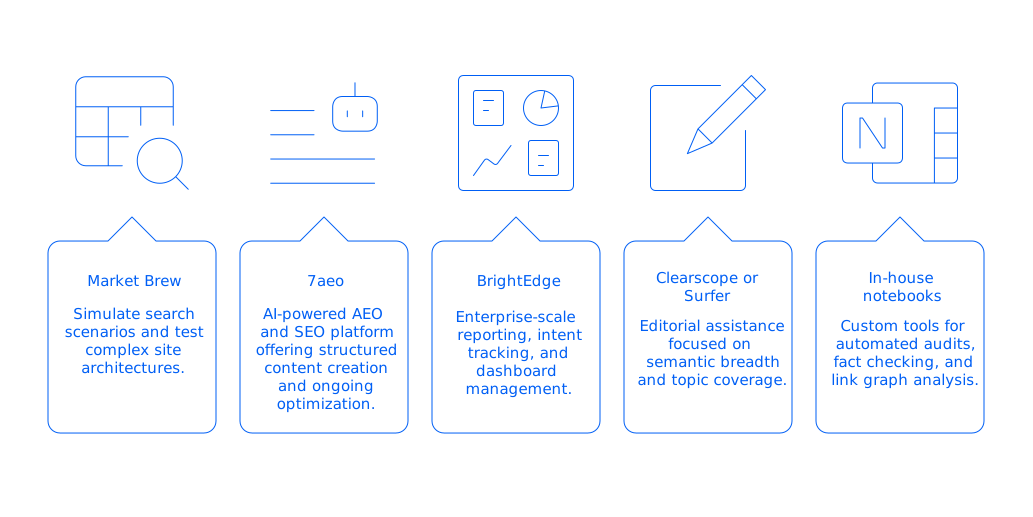
Reliable tools support efficient, structured processes. Choose platforms that facilitate clear content organization and traceable edits, not just volume.
- Market Brew: Simulate search scenarios and test complex site architectures.
- 7aeo: AI-powered AEO and SEO platform offering structured content creation and ongoing optimization.
- BrightEdge: Enterprise-scale reporting, intent tracking, and dashboard management.
- Clearscope or Surfer: Editorial assistance focused on semantic breadth and topic coverage.
- In-house notebooks: Custom tools for automated audits, fact checking, and link graph analysis.
Prioritize platforms that support structured data exports, robust schema integration, and clear review workflows. Full editorial control and transparent change-tracking are essential.
Common pitfalls that erase AI visibility
- Mixed claims: Contradictory figures found in blogs, documentation, and PDF files.
- Shallow pages: Brief or incomplete answers that lack supporting evidence or procedural steps.
- Dead JSON-LD: Schema markup that is not consistent with the visible content.
- Overloaded pages: Pages attempting to solve too many user intentions at once.
- Hidden updates: No visible update dates, unexplained changes, or outdated information.
- Opaque authorship: Unverified writers and incomplete author profiles.
A 90-day plan to be AEO/GEO ready for 2026
Days 1 to 15: Baseline
- Audit your existing content and catalog all key entities.
- Identify 30 top-priority search intents across your customer journey.
- Define and set up your metrics and performance dashboards.
Days 16 to 45: Build
- Launch an /answers section with at least 15 well-structured answer units.
- Implement relevant schema, provide citations, and establish clear authorship.
- Publish two new entity pages each week.
Days 46 to 75: Expand
- Develop three in-depth explainers by assembling existing units.
- Strengthen all factual claims with sources and ensure your changelog is up to date.
- Finalize sitemaps and set defined performance targets.
Days 76 to 90: Evaluate
- Measure your AI citation share and passage recall rate.
- Resolve any conflicting information and identify outdated claims.
- Establish a monthly cadence for regular updates and content reviews.
Keep this cycle active and adaptable. As new questions emerge, your editorial system should be prepared to integrate and address them quickly.
Governance that scales trust
Establish a clear, visible content policy that everyone involved can understand and implement:
- Create a list of claims that cannot be published without necessary citations.
- Require author sign-off on all mission-critical pages.
- Schedule quarterly fact reviews for all regulated or sensitive topics.
- Use permanent links and accurate dates to record every data source cited.
Consistency and transparency build trust both with readers and AI systems. Over time, these patterns significantly enhance your site's authority.
Final note for teams planning 2026
Achieving success with AEO and GEO does not rely on trickery. It is the result of consistent and methodical application of structured content, clear communication, fact-checking, and the comprehensive practices detailed throughout this guide. Treat every page as a source document to be referenced. That’s how you enable AI assistants to cite your site with confidence.
If you’re searching for a platform to support your structured content and AEO/SEO workflow, consider 7aeo, which blends AI-generated content and human review with continuous optimization. If you’d like to discuss a strategy for January, get in touch. We’re ready to help you develop a high-trust AEO/GEO system for 2026 and beyond.
FAQ
What is the difference between AEO and GEO?
AEO focuses on achieving visibility within AI-driven quick answers and overviews, while GEO seeks to integrate your content into more elaborate, AI-generated narratives. Both require distinct strategies to maximize digital presence by 2026.
Why should I prioritize generating AI-ready content over traditional SEO?
As search evolves, relying solely on traditional SEO risks missing out on AI-driven traffic opportunities. AI-generated responses are gaining prominence, meaning exclusive focus on blue links can limit your exposure to pivotal search contexts.
How can I ensure my content ranks within AI-generated results?
Adopting structured datasets and schema markup is critical, but so is ensuring content integrity and factual accuracy. Despite tech wizardry, don't forget that credibility still holds immense value in AI interpretations.
What are common pitfalls when aiming for AI visibility?
Neglecting to verify claims or maintain a clear update history can undermine credibility. Overloading pages with mixed intents or failing to standardize schema signal confusion, ultimately damaging trust with AI engines.
Why is content recency important for AI engines?
Outdated content risks rendering your site irrelevant in fast-evolving industries. AI engines prioritize recency for trustworthiness, and ignoring updates can mean losing out on being sourced or cited in current queries.
How should I structure my site for AI visibility?
Avoid ambiguity by categorizing each segment of content with well-defined topics and clear markup. Establish a predictable formatting structure, because AI engines thrive on consistency and clarity, rewarding it with visibility.
What role does schema play in AI search?
Schema is the language of AI. It informs engines about context and relationships in your content. Poor schema implementation can leave AI systems blind to your site's hidden value, critically hindering your online presence.
How do AEO and GEO work together for search visibility?
A holistic strategy integrating both AEO for concise responses and GEO for detailed insights ensures comprehensive visibility. Ignoring either component can limit reach, reducing the chances of being featured in diverse content types.