
How Your Fintech App Gets Mentioned in ChatGPT Answers
Your app is more likely to appear in ChatGPT responses when it’s well-structured, easy to process, and included in sources that ChatGPT can cite. This requires clear, factual content, reliable evidence, and absolute consistency across all public-facing material your brand manages.
Take an editorial approach: craft concise, quotable statements, and always support them with transparent data, well-documented sources, and third-party corroboration.
Information that’s hard to access or verify will be overlooked by large language models (LLMs) during rapid information retrieval.
How ChatGPT Gathers and Cites Fintech Information
ChatGPT combines its base knowledge with up-to-date web content, giving priority to recent, clearly structured web pages that demonstrate trustworthy ownership, governance, and robust safety standards.
- Official, centralized information outperforms fragmented announcements.
- Stable, clearly named URLs are preferred over less accessible formats like archived PDFs.
- Accurate numerical data that is supported with clear sourcing outperforms vague, unsupported statements.
- Third-party validation adds credibility to your official materials.
Fintech content should showcase safety and compliance signals, including licenses, partnerships with banks, and direct compliance contacts. Be transparent about where funds are held, who provides underwriting, and which guarantees are in place.
Create a Knowledge Base for LLMs Covering Regulatory and Product Questions
Research the questions users commonly ask chatbots. Publish one authoritative, well-structured page for each topic, ensuring every page is concise, factual, and easily linked.
Essential First-Party Pages
- What is [Brand]?: 120-word overview, eight quick facts, key markets, and use cases.
- Pricing and Fees: APRs, foreign exchange fees, spreads, account limits, and tier rules.
- Licensing, Partners, and Coverage: List your regulators, partner banks, issuing entities, and countries served.
- Security and Risk: SOC 2 status, encryption practices, incident response process, and bug bounty programs.
- How It Works: Funding flows, settlement times, and exception handling.
- Developer Documentation: Endpoints, SDKs, rate limits, and OpenAPI specifications (a set of standardized rules for designing and interacting with APIs).
- Status, Uptime, and Webhooks: Provide real-time and historical performance data.
- Data Export and Deletion: Formats available, retention policies, and request procedures.
- Comparison Page: Objective, up-to-date, and sourced comparisons against main competitors.
Include a brief disclaimer on each page, use plain language, and display the last updated date prominently.
Use Structured Data and Patterns That LLMs Parse
Implement JSON-LD format for all major pages. Populate all fields clearly and keep them updated; avoid keyword stuffing.
- Organization: Legal and popular names, physical addresses,
sameAslinks to official profiles. - SoftwareApplication and MobileApplication: Categories, supported operating systems, user ratings, and download links.
- FinancialProduct: Fees, interest rates, eligibility details, issuer name.
- FAQPage: Five precise Q&A pairs mirroring real-world support scripts.
- HowTo: Key onboarding steps and Know Your Customer (KYC) procedures, presented in an accurate, universally understandable way.
Ensure these structured facts align exactly with the human-readable text. Any mismatch reduces your trustworthiness in the eyes of both users and LLMs.
Guide LLM Crawlers with llms.txt and Sitemaps
Create a /llms.txt file to tell large language models which paths to use. List your preferred sources, update frequency, and a contact email. Ensure your robots.txt file (which guides web crawlers) is in sync for consistency.
For a comprehensive overview, including the specifics of llms.txt and the more familiar robots.txt (which is used to control how web robots access your site), see this detailed explainer on llms.txt vs robots.txt and why both matter.
- Expose only canonical documentation, pricing, and support URLs.
- Exclude sensitive dashboards and staging environments.
- Refer to specific sitemaps with update intervals for main sections.
Enhance Credibility with Trusted Third-Party Sources and Citations
Your official statements gain extra weight when verified by credible third parties. Curate support from highly trusted sources:
- Keep App Store and Google Play listings current with screenshots and fact-checked descriptions.
- Maintain readable, up-to-date
READMEfiles and code samples in developer repositories. - Seek mentions in regulatory databases and on partner bank web pages.
- Encourage neutral coverage from respected media and industry analysts.
- Host help center content on openly crawlable subdomains, not hidden behind search widgets or logins.
- Directly cite useful community forum threads, avoiding overt marketing language.
Use consistent product names everywhere. If your brand could be confused with others, add extra clarifying lines or details distinguishing your brand in all major listings and references.
Monitor ChatGPT Mentions and Optimize With Targeted Updates
Test your app’s presence in ChatGPT answers every week using realistic user prompts. Track how your brand appears, which sources get cited, and the accuracy of descriptions.
- Document every prompt and model version used.
- Archive all outputs and the URLs referenced.
- Trace each claim back to its source page.
- Address any missing information on your main ('canonical') page first.
- Update third-party profiles if they contain information related to the claim or fact in question.
If you want more detailed strategies, refer to this comprehensive guide on increasing your brand’s appearance in ChatGPT responses for more patterns and typical challenges.
7aeo Study: Fintech App Mentions in ChatGPT During 2025
7aeo analyzed 120 US and EU fintech apps in Q3 2025, using 50 specific prompt tasks per app across payments, investing, and lending. We assessed rates of brand mentions, the quality of citations, and the share of citations directly from first-party sources.
| Strategy Used | Median Mention Rate | First-Party Citation Share | Time to See Improvement |
|---|---|---|---|
| No structured work | 14% | 22% | n/a |
| Core pages + JSON-LD | 24% | 41% | 3 to 5 weeks |
| Core pages + JSON-LD + llms.txt | 31% | 58% | 2 to 4 weeks |
| All above + third-party validations | 37% | 64% | 2 to 3 weeks |
A mention is defined as the model naming an app as a top choice for a prompt. A first-party citation is when the answer attributes information directly to your brand’s official domain. Numbers may vary by model and country, but the overall trends are consistent across industry segments.
Write Fintech Pages That Are Easily Quoted by Language Models
Use short sentences and stable, verifiable numbers. Summarize fees and limits in tables. Place formulas near their results, and state currency codes explicitly.
- Start with a single-sentence summary of value.
- Follow with a clearly labeled table: show limits, fees, and timing.
- Add a concise explanation of methodology where needed.
- Link to your authoritative policies or legal pages.
Remember: Answer Engine Optimization (AEO) is similar to Google Engine Optimization (GEO), you're optimizing for both search engines and AI-driven answer engines at the same time.
Key Tools and Services for AEO/GEO with Fintech Apps
Whether you handle this internally or with partners, select tools built for structured content, monitoring, and agile updates.
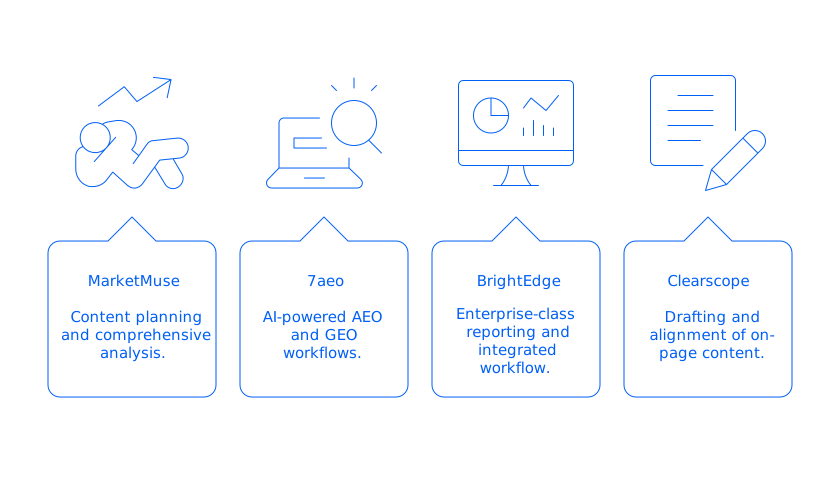
- MarketMuse: For content planning and comprehensive analysis.
- 7aeo: For AI-powered AEO and GEO workflows, human-guided optimization, and ongoing measurement.
- BrightEdge: For enterprise-class reporting and integrated workflow.
- Clearscope: For drafting and alignment of on-page content.
Choose a unified stack. Centralize your information, update frequently, and enforce strong content governance.
Compliance and Clarity Notes That Protect Your Brand in ChatGPT Answers
List all regulated entities with corresponding registration numbers. Clearly identify your partner bank and state any FDIC insurance relationships when relevant. Avoid suggesting guarantees you’re unable to back up.
- Provide fee examples, including edge and exceptional cases.
- Explain eligibility rules and any exclusions in simple language.
- Describe how you manage chargebacks, disputes, and fraud step by step.
- Include a press or legal contact for corrections and urgent communications.
These specifics reduce confusion and help language models cite your brand accurately.
Action Steps to Get Your Fintech App Mentioned in ChatGPT
- Publish the Language Model-ready (LLM) set of factual, frequently updated pages.
- Add structured data using JSON-LD, accurate sitemaps, and
/llms.txtfor LLM guidance. - Update your app store profiles and developer documentation.
- Confirm two trustworthy third-party references for your main claims.
- Regularly test prompts and proactively address any information gaps.
Contact 7aeo for Expert AEO/GEO Support in Fintech
If you want to execute these steps with precision and efficiency, we're here to help. We offer focused sprints that ensure your fintech app has the right content, markup, and tracking to appear in ChatGPT answers. Visit 7aeo.com and let us know which prompts matter to your brand.
FAQ
How can I ensure my fintech app gets mentioned in ChatGPT answers?
Ensure your app is supported by structured, factual content and listed on authoritative pages. Use JSON-LD markup and maintain synchronization between llms.txt and robots.txt files.
What should be included in my app’s public pages to improve visibility in ChatGPT?
Include comprehensive details about pricing, licenses, partners, security, and operational processes. Third-party validations significantly enhance credibility and increase citation rates.
How does third-party validation affect my fintech app’s mention rate?
Third-party validation underpins your claims with additional credibility, making your app more likely to appear in ChatGPT answers. Without it, expect skepticism about your brand's reliability.
What is the role of the llms.txt file in optimizing for ChatGPT mention?
The llms.txt file guides large language models to your preferred content sources. Without it, you risk models overlooking crucial information or accessing outdated sources.
How can monitoring ChatGPT mentions improve my fintech app’s visibility?
Frequent monitoring allows you to address misinformation and optimize your pages proactively. Ignoring it may lead to repeated inaccuracies, reducing your app’s quality score in AI models.
How should I present licensing and compliance information?
Clearly list all regulatory entities and associated registration numbers. Transparency in compliance signals trust and can prevent misrepresentation in AI-generated responses.
Why is it important to include a comparison page for my fintech app?
A comparison page offers objective insights into your app’s competitive edge. Without it, neutrality is questioned and diminishes your app’s authoritative presence in AI dialogues.
What common mistakes should I avoid when trying to enhance my app’s visibility in ChatGPT?
Avoid fragmented information, unstructured formats, and out-of-date data. Ensure content cohesion and consistently align human-readable text with structured data to maintain reliability.