
Stop Guessing: Understand What Google Actually Sees
You cannot fix what you cannot see. Start your SEO process by verifying exactly what Google crawls, renders, and indexes on your website. Guesswork can lead to inefficient use of valuable time and delay results.
Quick Tests to See What Google Sees
- Run site: searches to get a sense of your site's indexed quantity and spot any unexpected URLs.
- Use Search Console’s Pages and URL Inspection tools. Examine indexability, canonical tags, and the last crawl date for important URLs.
- Use the Rich Results Test on key URLs to make sure your structured data meets Google’s requirements.
- Leverage the live test within URL Inspection to check rendered HTML and spot missing or hidden content.
- Review robots.txt, meta robots, and x-robots-tag directives. Remove accidental
noindex
tags immediately.
Document your findings carefully. Tag each issue by its potential impact and estimated effort to fix. This becomes your actionable plan.
Mistake 1: Page Content Doesn’t Match User Intent on the SERP
Google prioritizes pages that fit the intent behind a search. Your page format needs to align with where users are in their journey.
- Transactional: Product or service pages, clear calls to action, and direct comparisons.
- Informational: Tutorials, guides, FAQs, and definitional content.
- Navigational: Brand homepages, login pages, and documentation hubs.
- Comparison: Versus pages, lists of alternatives, and side-by-side matrices.
- Local: Location-specific pages with NAP (Name, Address, Phone), reviews, and business hours.
How to Fix
- Match each target keyword or query with the intent shown on the current SERP.
- Ensure your page format and content depth are appropriate, avoid using a blog post for a transactional query, for example.
- Cover subtopics found in top-ranking results and the “People Also Ask” section.
- Present a clear, one-sentence answer or summary near the top of the page.
Mistake 2: Content Is Thin, Generic, or Unhelpful
Simple rewrites rarely perform. Users and search algorithms both favor content with depth, evidence, and actionable steps.
- Clearly state the main takeaway or value within the first two paragraphs.
- Demonstrate steps using screenshots, code snippets, or tables as needed. Keep advice practical and grounded.
- Quote sources and include dates when referencing statistics or prices.
- Present counterexamples, highlight pitfalls, and discuss relevant edge cases to provide a rounded perspective.
- Add a concise summary at the end of the page, and provide an FAQ addressing real objections or follow-up questions.
If your content is too generic and does not stand out, it will not rank well in search results.
While AI can help generate content drafts, adding first-hand insights can make your content stand out. Incorporate details from your own experience, logs, feedback, or notes, and cite these sources when possible.
Mistake 3: Technical Issues Hide Your Pages
Even one wrong setting can make months of content invisible to Google. Always check technical basics before rewriting or adding new pages.
- Remove stray
noindextags and incorrect canonical links. - Correct robots.txt files that may block essential URLs or directories.
- Resolve redirects (3xx chains), broken links (404 errors), and issues with mixed protocols (HTTP/HTTPS).
- Identify and manage duplicate content and unnecessary URL parameters using canonicals or redirect rules.
- Validate hreflang pairs for international sites to avoid conflicts and ensure proper language targeting.
- Ensure critical page content is available without reliance on JavaScript wherever feasible.
- Focus on improving Core Web Vitals, particularly LCP (Largest Contentful Paint), INP (Interaction to Next Paint), and CLS (Cumulative Layout Shift).
- Implement server-side caching and a content delivery network (CDN). Compress images and optimize font delivery.
Quick Wins
- Implement XML sitemaps for each category such as blog, product, and document pages.
- Submit these sitemaps in Search Console and monitor for errors or warnings.
- Address template-level code issues before making individual page adjustments.
Mistake 4: Poor Internal Linking and Orphaned Pages
Even great pages need effective internal links to perform. Internal linking helps distribute authority and context within your website.
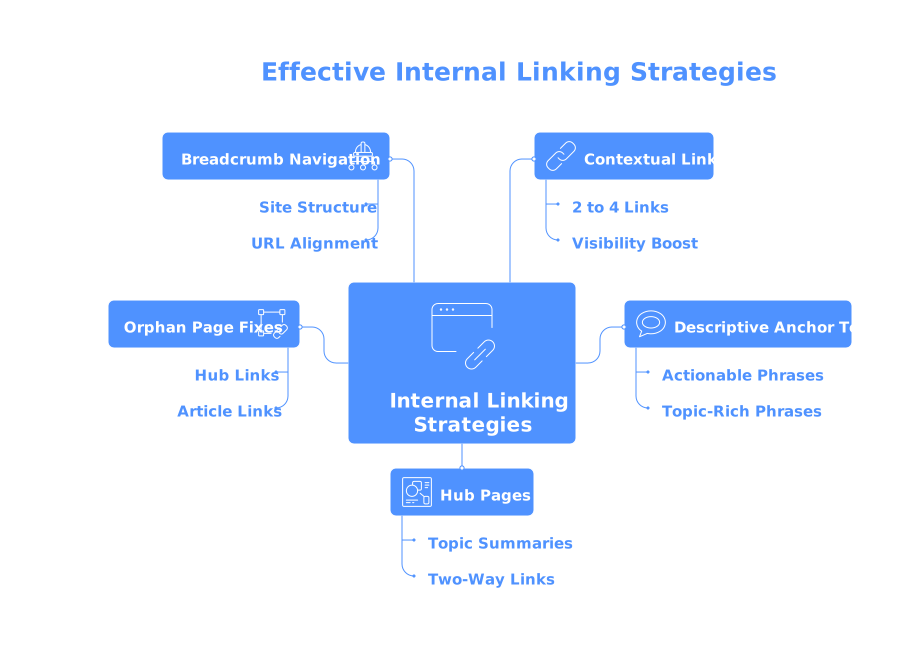
- Add 2 to 4 contextually relevant internal links from other pages to boost your target page's visibility.
- Use descriptive anchor text, favoring actionable or topic-rich phrases over generic text like
learn more
. - Create hub pages that summarize each major topic, offering two-way links to and from related content.
- Identify and fix orphan pages, pages that lack any internal links to them, by linking them from hubs and relevant articles.
- Implement breadcrumb navigation reflecting your site structure, and ensure URLs align with your organizational taxonomy.
Mistake 5: Disorganized Site Structure and Deep Crawl Paths
Pages buried deep within your site are crawled and ranked less frequently. Make key information accessible and reduce unnecessary complexity.
- Keep important pages no more than three clicks away from the homepage.
- Use clean, human-readable URL slugs that reflect your core topics, avoid using dates or irrelevant numbers.
- Remove low-value tag pages and empty archives that don’t serve any search intent.
- Organize sitemaps by section and keep each under the 50,000 URL limit.
- Consolidate duplicate content caused by issues like trailing slashes, uppercase/lowercase discrepancies, and tracking codes.
Remove inactive or irrelevant pages that can create unnecessary distraction or clutter. Merge overlapping content into stronger, more comprehensive resources.
Mistake 6: Missing Structured Data and Answer Formatting
Search engines and AI use structured data to understand and present information. Add machine-readable details to improve your site’s visibility and eligibility for enhanced results.
- Apply JSON-LD schema for content types like Article, HowTo, FAQPage, Product, and Organization where appropriate.
- Mark up product ratings, prices, availability, and relevant images whenever possible.
- Open pages with a clear definition or solution statement for direct relevance.
- Present step-by-step instructions with ordered lists (
<ol>) for clarity. - Include a brief FAQ section to address additional or related search intents.
- Validate all structured data implementation with the Rich Results Test and Google Search Console.
Mistake 7: Overlooking Entities and E-E-A-T Fundamentals
Entities help Google connect your brand to key topics, while trust signals unlock higher rankings and boost user conversions.
- Add author bios with evidence of expertise and links to their public profiles.
- Publish editorial guidelines and describe your content review process for added credibility.
- Include Organization schema with your legal name, logo, and social or industry profiles via
sameAslinks. - Cite primary and authoritative sources using links to standards, documentation, or datasets whenever possible.
- Publish meaningful original research or benchmarks, and describe your methods and dates.
- Show bylines, publish and update dates, and explain any changes or updates to the content.
These improvements support both SEO and user trust. Visitors decide quickly whether to trust your content or move on.
Recommended Tools and SEO Partners
Reliable tools speed up your SEO diagnosis and ongoing improvement. Use a mix of research, crawling, and publishing solutions for best results.
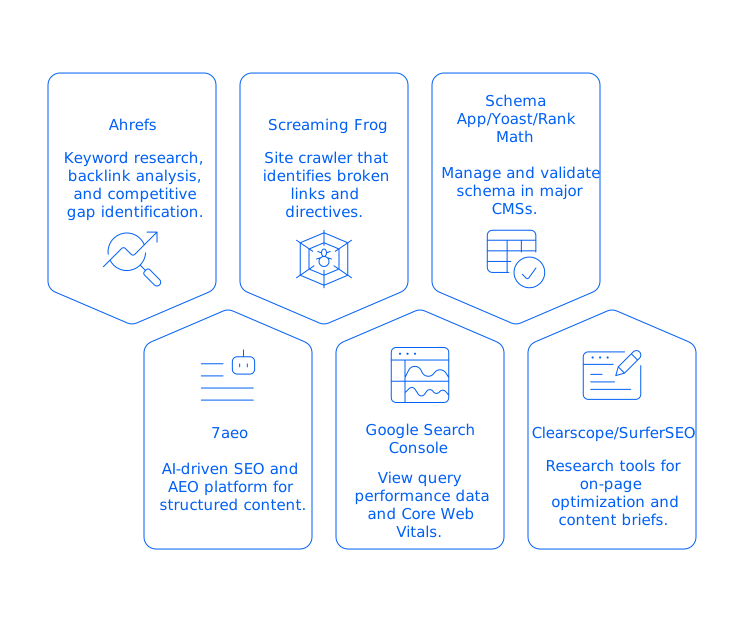
- Ahrefs: Powerful for keyword research, backlink analysis, and identifying competitive gaps.
- 7aeo: An AI-driven SEO and AEO platform for structured, human-supervised content and ongoing optimization. Learn more about practical, always-on content solutions.
- Screaming Frog SEO Spider: Comprehensive site crawler that identifies broken links and problematic directives.
- Google Search Console: View query performance data, coverage reports, and Core Web Vitals tracking.
- Schema App or Yoast/Rank Math: Solutions for managing and validating schema in major CMSs.
- Clearscope or SurferSEO: Research tools for on-page optimization and detailed content briefs.
Choose the tool stack that matches your team size and your release process.
Your 30-Day SEO Fix Plan
- Week 1: Crawl your website, review Search Console’s Pages section, and address any indexation blockers. Update or remove outdated sitemaps. Fix broken internal links.
- Week 1, Day 3: Analyze your top 20 search queries, mapping each to user intent and appropriate page types. Document any mismatches for correction.
- Week 2: Rewrite five key pages to better match search intent. Add a clear summary, well-delineated steps, and a targeted FAQ to each.
- Week 2, Day 4: Add contextual internal links from related pages and topic hubs. Eliminate any orphaned content.
- Week 3: Implement JSON-LD structured data on priority page templates. Validate markup and submit for indexing in Google Search Console.
- Week 3, Day 3: Optimize page speed by improving LCP and CLS scores. Compress images and defer non-critical scripts.
- Week 4: Launch a comprehensive topic hub and two comparison pages. Add detailed author bios and company information.
- Week 4, Day 4: Set up dashboards to track search queries, click-throughs, and indexed pages. Review progress after one week.
Maintain a changelog that ties each improvement to a specific metric. This will help you clearly track what drives results.
Essential Checks Before Publishing
- Keep your page title under 60 characters, with the main keyword near the beginning.
- Write a meta description of around 155 characters, promising a clear benefit or result.
- Ensure each subtopic has a clear
<h2>header, avoid filler headings. - All images must have descriptive alt text and be optimized for fast loading.
- All schema markup validates successfully with no critical errors or warnings.
- Include at least three relevant internal links to and from related pages.
- Confirm your templates achieve good Core Web Vitals scores (all green).
- Your page should display a byline, updated date, and clear references to sources.
Most ranking issues can be traced back to these core fundamentals. Address them with diligence and structure rather than quick hacks.
If you want ongoing, structured content fit for both search engines and AI platforms, consider working with a focused partner. Contact 7aeo for a practical SEO and content plan matched to your business roadmap.
FAQ
How can I ensure Google is indexing the right pages of my site?
To confirm Google indexes the pages you deem important, use the Search Console URL Inspection tool to check indexability and canonical tags. Fix stray 'noindex' and poor crawl instructions that mistakenly bury valuable content.
Why is aligning content with user intent critical for SEO?
If your content doesn't match user intent, it will fail to satisfy search queries, leading to poor rankings and missed opportunities. Search engines prioritize relevance, so adapt your content structure to reflect transactional, informational, or navigational intents.
What are the risks of not resolving technical SEO issues?
Neglecting technical SEO creates a minefield where your best content remains unseen. Broken links, crawl errors, and incorrect directives can obliterate your organic visibility before it even begins.
How can internal linking enhance my site's performance?
Strategic internal linking reinforces content hierarchy and shares link equity across your website. Fail to handle it, and you're leaving on-site SEO juice untapped, disadvantaging pages needing visibility boosts.
What consequences arise from poor site structure?
A chaotic site structure convolutes navigation and extinguishes any potential for efficient crawling. This inefficiency results in reduced crawl rates and delays in content rankings, reflecting badly on user experience as well.
Why is structured data integral to SEO?
Structured data aids search engines in understanding page context, directly influencing search result quality and rich snippet eligibility. Neglecting it means missing out on enhanced search visibility and user engagement.
How do entities and E-E-A-T affect SEO?
Entities and trust signals (E-E-A-T) forge connections between your brand and associated topics, bolstering authority. Overlooking them equates to surrendering credibility and user trust, which can drastically undermine search performance.